Understanding Half-Drop, Brick and Tossed Repeats: A Pattern Layout Explainer
A repeat is the quiet promise a pattern makes: that nobody will notice the join. Whether you are laying out wallpaper, a printed length of cotton or a digital background, the repeat layout decides how your motifs sit beside one another — and how quickly the grid starts to show. Three arrangements do most of the heavy lifting: half-drop, brick and tossed.
They all begin with the same question. You have a tile; how does the next one line up against it? Answer that well and the surface reads as considered and deliberate. Answer it badly and you get wobbly stripes you never intended, or a knot of motifs at the tile edge that repeats across the wall like a scar.
Straight repeats set the baseline
The default is the block or straight repeat: motif above motif, column beside column, everything aligned. Plaids, grids, spot prints and most geometrics live here. It is easy to build, easy to print and easy to line up, which is exactly why it can look stiff. Because every motif sits on a shared horizontal and vertical line, the eye finds the ladder immediately.
Straight repeats work when the rhythm is the design — a two-colour stripe, a ticking, a strict checkerboard — or when the motif is large enough that the grid reads as architecture rather than accident. If a layout feels mechanical and you cannot say why, the straight repeat is usually the culprit.
Half-drop: shift every other column by half
A half-drop repeat takes the block grid and moves alternate columns (or rows) by exactly 50 per cent of the tile's height. Nothing else changes: same spacing, same scale, same palette. The effect is a diagonal drift. Motifs step down and across instead of stacking, so the eye travels on the diagonal and the hard horizontal lines dissolve.
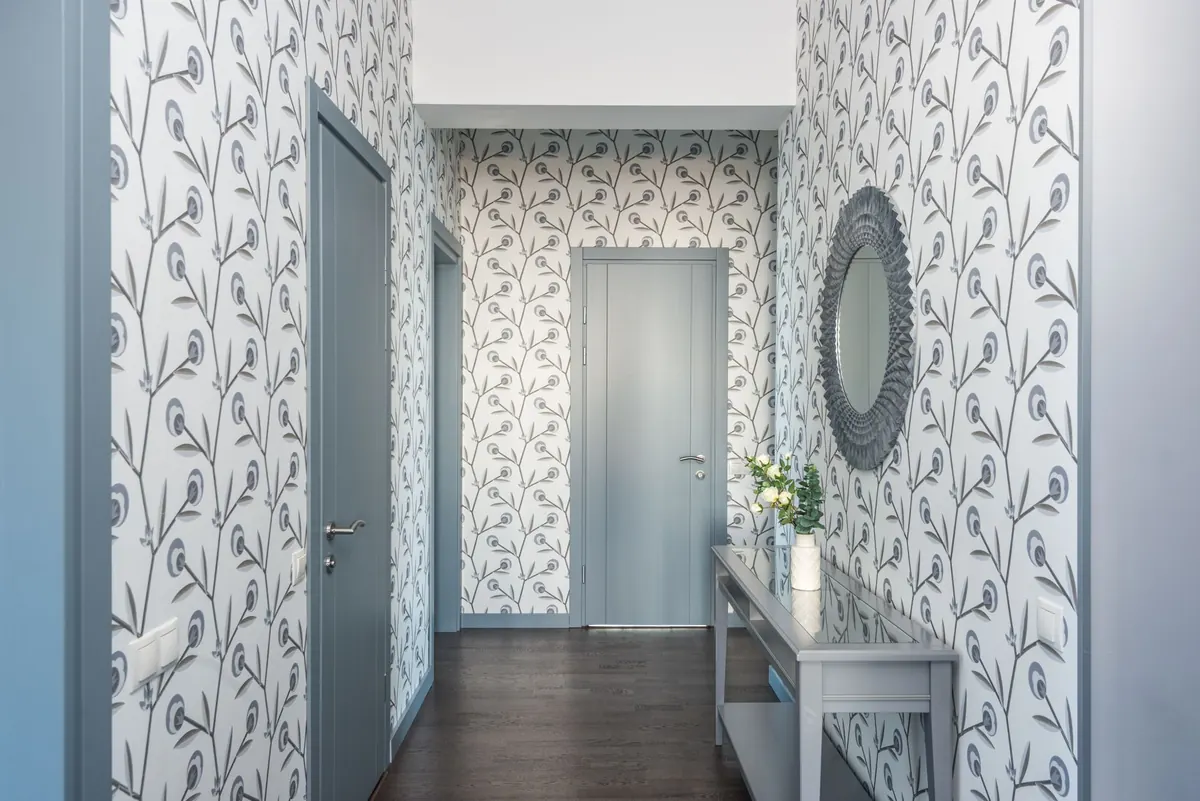
This is the layout behind a great many florals, damasks, trellises and decorative tiles. It behaves well for motifs with a clear vertical axis — a stem, a vase, an urn — because the offset stops them marching. It also reads as intentional rather than random, which makes it a sensible middle ground when a brief asks for "more movement" but nothing needs redrawing.
Wallpaper labels often name the match type, and half-drop appears there regularly. A straight or half-drop match is generally quicker to trim and hang than a random match, which matters if you are specifying or printing rather than just sketching.
Brick: stagger the rows
A brick repeat offsets each row sideways by a set fraction of the motif's width — most often half, though a third or a quarter is perfectly valid. The rhythm is horizontal and architectural: think stock brick, subway tile, strung scallops, fish scales, dashed stripes.
It suits motifs that are wider than they are tall, and patterns where you want the row to read as a course rather than a column. Brick keeps more of the grid's order than half-drop does; the horizontal bands stay legible even as the vertical ones break up.
Terminology drifts between studios and printers, and you will meet people who call any 50 per cent stagger a half-drop, whatever the direction. What matters in practice is the axis and the proportion. Am I shifting a column down, or a row across? And by how much? Those two answers define the layout, whatever the label.
Tossed: scatter with the seams in mind
A tossed repeat places motifs at varied positions, angles and sometimes sizes across the tile, so no grid is visible. It is the layout of speckles, small stars, scattered leaves, tiny animals and confetti-like backgrounds. Loose, lively, and forgiving of motifs that are not quite symmetrical.
It is also the easiest of the three to get wrong. Tossed layouts can clump, leaving awkward gaps; they can flatten if the scale is too small, or turn spotty if the scale is too large. And because there is no grid to hide behind, a badly finished edge shows immediately.
A reliable method is to build a skeleton first. Set up a half-drop or brick grid, place one motif per cell, then nudge each motif off its position, rotate it a few degrees and vary the size slightly. You keep the even distribution and lose the mechanical feel.
Choosing between them
If you are deciding quickly, these rules of thumb cover most briefs:
- Grid is the point — plaid, ticking, checkerboard, tile: straight repeat.
- One clear motif, needs air — floral, damask, trellis, medallion: half-drop.
- Wide, short motif — scales, scallops, dashes, brick shapes: brick.
- Many small motifs — stars, speckles, petals, animals: tossed, built on a hidden skeleton.
- Directional motif — arrows, birds in flight, anything that must read up or down: straight or half-drop, so the direction stays coherent.
- Large panel or mural — treat the whole wall as the tile and let the repeat fall where it must: straight, with careful placement.
Building and checking the tile
Whichever layout you choose, the work is in the edges. A short routine saves hours:
- Fix your tile size and write it down. Square tiles are easiest to reason about; rectangles are fine if the ratio stays simple.
- Place your core motif, then create the offset with a copy-and-move rather than by eye. In vector tools, move the copy by exactly 50 per cent of the tile dimension and let it repeat; in raster tools, an offset filter set to wrap sends edge content to the opposite edge so the join becomes visible.
- Fill the four corners of the tile. Corner content is where repeats usually fail.
- View the tile in a grid of at least three by three. One tile on its own tells you nothing; nine tiles tell you the truth.
- Scale up and down. Check the pattern at a metre across and at its final printed size, whether that is a phone screen or a length of cloth.
- Print a sample if you can. Paper and fabric change how much contrast the join carries.
Start with structure, then loosen it
Choose the repeat before you fall in love with the drawing. Straight repeats give you clarity, half-drop gives you flow, brick gives you rhythm, and tossed gives you freedom at the cost of control. Most strong patterns sit on a disciplined skeleton — half-drop or brick — with a little deliberate irregularity on top. Get the skeleton right and the looseness reads as style rather than guesswork.
Photo: Max Vakhtbovych / Pexels