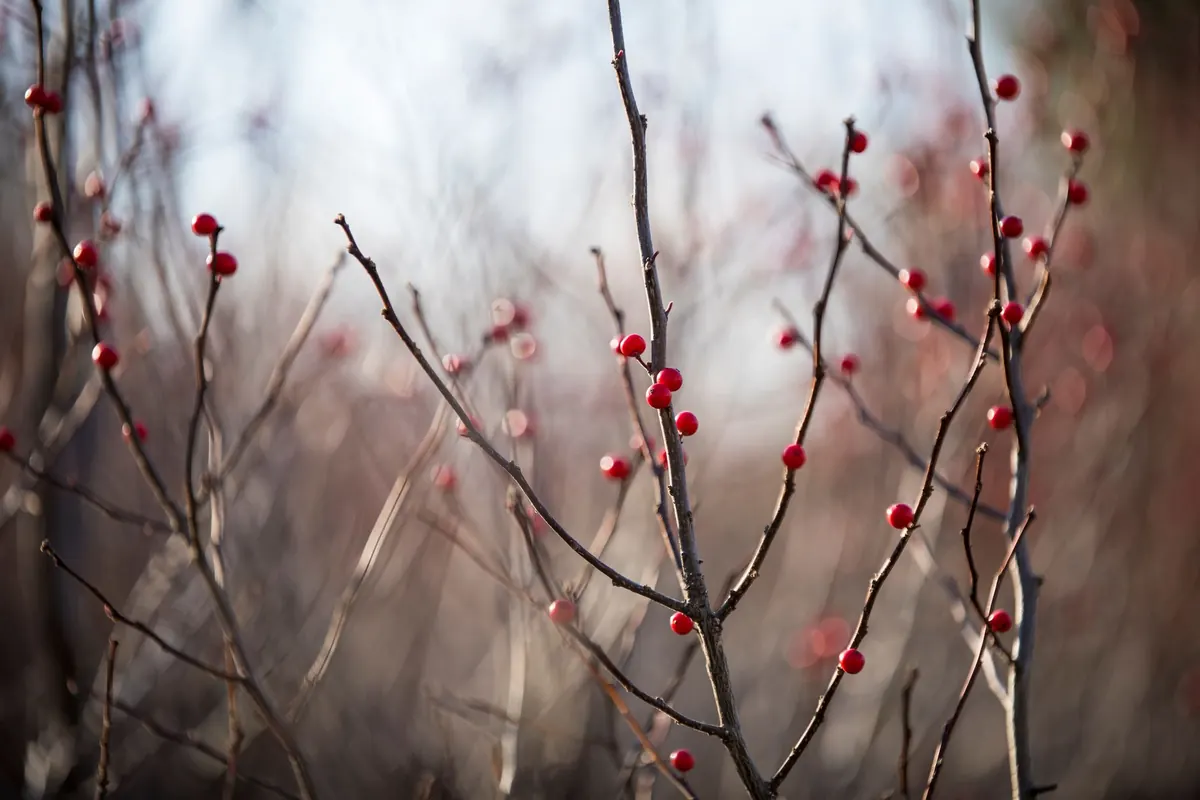
Winter Botanicals: Designing Festive Motifs from UK Evergreens
By December the garden has thinned out to its bones, and that is exactly when the British landscape gets interesting. Holly holds its shape against a grey sky. Ivy spreads across a wall in flat, deliberate planes. Teasel stands empty and architectural in a ditch. Everything still upright is structure, and structure is what a motif needs. What follows is a working guide to turning those plants — leaves, berries and seed heads — into festive patterns you can draw, cut, print or repeat.
What a UK Winter Actually Offers
The plants still standing in January are the tough ones, and they hold their shape. Holly is generous: prickly leaves low down, smooth-edged leaves higher up on the same tree, which gives you two motifs from one sprig. Ivy carries lobed juvenile leaves and arrow-shaped adult ones. Yew keeps dark needles and a scarlet aril. Scots pine hangs bundles of needles and small woody cones; spruce and fir give you longer cones with scales that flatten beautifully into a scallop pattern. Mistletoe adds paired oval leaves on a forked stem.
Then come the accents. Holly berries in scarlet, rosehips in orange-red, sloes blue-black with a haze of bloom, ivy berries almost black, rowan in tight orange clusters. Seed heads do the quieter work: teasel's spiny egg, honesty's translucent silver discs, allium's papery stars, poppy and nigella rattling in the wind. The best festive motifs usually come from one or two of these, not six. Choose a hero plant and let the rest support it.
From Plant to Shape: Reading the Silhouette
Most plant motifs fail because the maker draws the plant rather than the shape of it. Trace the outline first as one continuous line, ignoring veins, shine and texture. Then ask yourself whether it still reads at the size of a postage stamp. A few reliable reductions:
- Holly leaf: a pointed oval with five to seven spines, mirrored left to right. The trick is that the spines should point outwards and slightly forward, never straight up.
- Ivy leaf: a rough pentagon with three concave scoops cut out of it. Draw the scoops first, then join the points.
- Pine or fir: a fan of thin wedges radiating from a short stem. Vary the wedge lengths or it turns into a comb.
- Teasel: an egg with a comb of short spikes along two sides, plus a stem. Almost abstract already, which is why it works so well on a small scale.
- Honesty: a circle with a smaller circle inside and a faint line through the middle. Two shapes, and it reads instantly.
Once the silhouette holds, detail can return — a paler central vein on an ivy leaf, one highlight on a berry. But if the shape fails small, no amount of detail will rescue it.
A Palette Pulled from the Hedge
Winter colour is duller and bluer than the Christmas-card version, and copying that honesty is what makes a design feel British rather than imported. Holly green in shade is close to black; in low sun it flashes yellow-green. Spruce needles carry a blue-grey bloom. Yew is so dark it reads as texture rather than colour. Mistletoe sits somewhere between sage and lime. Ivy is a leathery mid-green with pale veins.
Set one or two greens against a single berry accent — scarlet, orange-red or blue-black — and add a neutral: oatmeal, kraft brown, or the bone colour of dried stems. Three colours plus a neutral is usually enough. Work on off-white or brown paper rather than pure white; it settles the greens and makes the reds look less like plastic.
Turning a Sprig into a Repeat
- Draw one sprig properly first. A repeat built from a weak unit never improves.
- Choose a repeat structure. A block repeat is a simple grid. A half-drop repeat shifts every second row across by half, which stops the pattern looking like wallpaper. A mirrored repeat flips alternate tiles and gives you that ogee effect you see on old wrapping paper.
- Set the spacing. The gap between sprigs should be roughly equal to, or a little less than, the width of the sprig itself. Too wide and it reads as scattered.
- Copy, paste and check. Build at least three rows and three columns before judging it. Patterns that look lovely as a single tile often turn into accidental diagonal stripes.
- Test it in a mirror, then on a screen at thumbnail size. Both reveal clumsy joins faster than staring at the original.
Techniques Worth Trying
- Linocut or rubber stamp: cut the silhouette and print it in one flat colour. Best for seed heads, where the shape is already bold.
- Paper cutting: fold and cut a repeating border. Excellent for ivy, which tolerates symmetry well.
- Gouache or watercolour: build two or three greens in loose washes, then draw the veins back in with a fine brush.
- Vector drawing: the cleanest route to a true half-drop repeat, and the easiest to recolour for cards, tags and digital use.
- Stencil and screen printing: good for gift wrap, where you want the motif to run off the edge of a sheet.
- Embroidery or felt: a simple running stitch along a holly spine or a teasel comb gives a motif you can hang rather than print.
Where the Motifs Go
Keep the scale small and the applications multiply. A single sprig stamps neatly onto a gift tag. A border of alternating holly and ivy runs along the edge of a card. A half-drop repeat makes wrapping paper that never looks repetitive, because the eye cannot lock onto a grid. The same sprig, mirrored four ways, becomes a wreath shape with a hole in the middle.
Seed heads are the most versatile of all. A teasel printed in one dark brown on kraft paper looks like a bought design; add a single berry-red dot and it looks deliberate. Honesty, printed in silver-grey on a darker ground, gives you something close to frost without a single sparkle.
Before You Cut: A Short Checklist
Foraging for a few sprigs is one thing; stripping a hedgerow is another. In general terms, you should not uproot wild plants without the landowner's permission, and some species and sites are specially protected — nature reserves, SSSIs and council-managed parks usually have their own rules, so ask before you take anything. Take from your own garden or a friend's first.
- Cut sprigs with clean secateurs and leave the leading stems so the plant keeps its shape.
- Never strip a bush bare. Berries are winter food for birds, and a holly without berries is a poor motif anyway.
- Holly berries, mistletoe berries and yew arils are all best kept away from children and pets, and hands should be washed after handling. If you plan to dry or sell foraged material, check the rules that apply to your area.
- Condition cut material in cool water overnight, then store it somewhere cold and dark until you use it. Seed heads dry best hung upside down in a dry room.
Start with one plant you can see from your kitchen window. Draw it three times, badly, then once properly. That fourth drawing is your motif, and it will carry you through the whole of the winter.
Photo: 정규송 Nui MALAMA / Pexels